Tetsuya Theodore Fujita
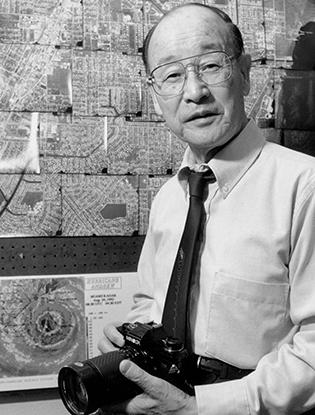
“[They] said: ‘You’re dead wrong.’ But I still pursued my concept.“
Dr. Tetsuya “Ted” Fujita was born in Sonemura, Japan on Oct. 23, 1920. As a teenager, Fujita became fascinated with storms, and pursued a career in science. Fujita obtained a B.S. from Meiji College in 1943 and D.Sc. from Tokyo University in 1950 studying Mechanical Engineering. Fujita’s thesis was an analytical studies of typhoons in which he measured storms from a mountain-top observatory and analyzed the destruction from the nuclear bombs dropped on Hiroshima and Nagasaki to understand the effects of shockwaves on trees and structures. After graduating, Fujita worked as an assistant professor at the Kyushu Institute of Technology. In 1953, impressed by Fujita’s work, faculty at the University of Chicago offered Fujita a tenured faculty position in the physics department. Fujita continued to study severe storms and winds and would visit over 300 tornado sites for his research. Fujita would invent the f-scale for rating tornado intensity and help develop the understanding that intense tornados are formed of multiple vortices, despite criticism. Fujita also discovered microbursts, a dangerous wind phenomena that could not be seen on airport weather monitors, which helped develop wind shear checks and has improved flight safety. Fujita was nicknamed “Mr. Tornado” throughout his career and has a PBS documentary highlighting his work.